Expertise Analytics & Reporting

Analytics & Reporting

We understand how data moves through your system and how to turn it into information you can use to run better.

You don’t need more data. You need to know what it’s telling you.

From the plant floor to the ERP, we know how data is captured, connected, and reported.

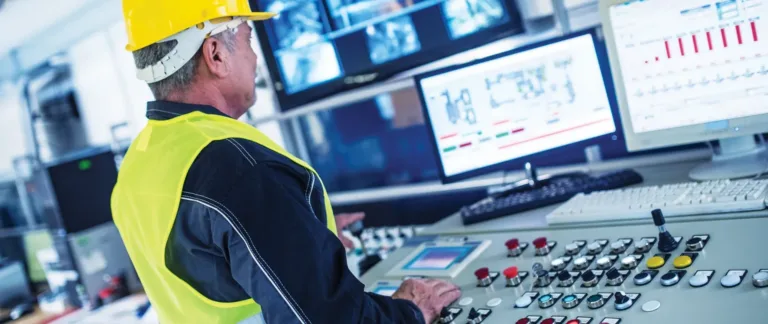
Engineer in a blue shirt works at dual monitors showing a controller block diagram and data trend charts.

Data Collection & Analysis

Collecting process data is foundational to an effective manufacturing ecosystem, but on its own is no more useful than a foundation without a building atop it. We use its broad cross-industry experience to help clients analyze process data to drive process improvement.

Data collected in batch manufacturing must have the context to be useful for analysis. Different products (recipes) use varied parameters. What is scorching hot to one recipe or recipe phase is just right for another. With context, data can be properly analyzed and understood. Our experience in collecting data with appropriate context then analyzing it within that context can help you better understand and improve your batch manufacturing ecosystem.

OEE / OBE

OEE is a calculated value that considers part quality, performance, and availability. OEE is oriented toward discrete manufacturing. It directly applies to food, beverage, and pharmaceutical packaging operations and is used widely there. Effective equipment utilization is part of an effective manufacturing ecosystem.

Applying OEE directly to batch operations is abstract, because batch operations intentionally stop and start, produce different products at different rates, and measure the quality of an entire batch rather than small portions. What we call Overall Batch Effectiveness (OBE) considers quality, performance, and availability in relation to a batch or campaign rather than to a piece of equipment. OBE is as valuable for improving batch manufacturing as OEE is for improving discrete manufacturing.


The control system was integrated with the plant ERP system (both top-down and bottom-up), allowing (a) production shop orders to be sent to the plant floor system for execution and (b) material usage, lot data, and production totals to be reported back to the plant ERP system.

— Magnum’s Controls & Process Automation Group Case Study Narrative

Explore More To Run Better

See how data flows across systems and how important it is for making day-to-day decisions.

Market-Leading Insights

Read about what the data shows in real-world operations and how our customers are using it.

More Success Stories

Read about how data clarity is showing up in real-world operations and how our customers are using it.

Request a Proposal

Not getting what you need from your data? Let’s take a look at how it’s flowing and what’s missing.

Related News & Resources

How data is used to improve decisions across real-world operations.

An operator works at a workstation with four computer monitors displaying control panel interfaces and data dashboards in a monitoring room.

Building Cyber-Resilient Process Control Systems: 9 Practical Steps to Protect Your Digital Investments

A single cyberattack can halt production, corrupt data, and cost you days of lost output. That’s why more plant leaders are asking the same question: how do we build cyber-resilient process control systems that reduce the risk of downtime and keep operations running? The good news is that resilience isn’t luck. It’s a disciplined, repeatable process you can start today. Why Cyber Resilience Matters Now Your plant floor runs on connected technology. PLCs, HMIs, SCADA platforms, and networked instrumentation communicate with each other and with your business systems. That connectivity drives efficiency, but it also expands your attack surface. For decision-makers, the …
Continue Reading 
A light-skinned man wearing a white hardhat and reflective vest points with a pen at multiple computer screens showing data and charts in a control room.

The Competitive Edge You’re Missing: Why Controls Integration and System Integration Are Better Together

Running a plant, or multiple plants, means managing a web of moving parts. Equipment communicates with software. Software talks to operators. Operators make timely decisions based on data they are confident is accurate and available in real time. But when your systems aren’t truly unified, the web quickly frays. This is why it is critical to understand the difference between system integration and controls integration—and, more importantly, why combining them is a game-changer for operational leaders like you. What Is System Integration? System integration is the process of connecting your disparate IT and OT (operational technology) platforms into a single, cohesive …
Continue Reading 
Get Started