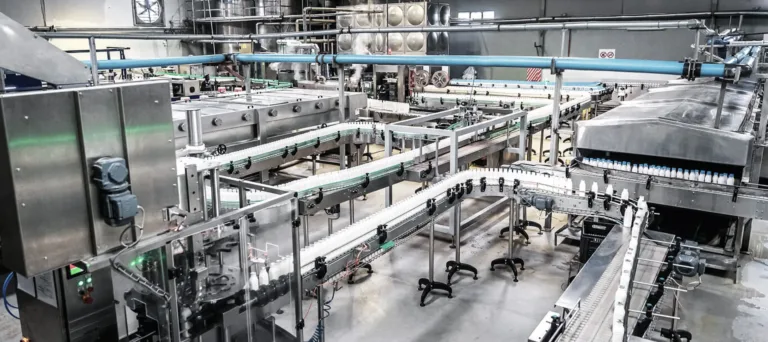
Packaging Application – Asphalt: The system needed to be integrated into an existing building. The main challenge was bringing in the material from outside, where it was delivered by a dump truck. We devised an internal packaging line that addressed these external constraints.
We designed and built a complete packaging system for filling and palletizing 50 lb (22 kg) bags, including an external material-loading hopper, an incline auger packaging machine, a bag sealer, conveying, and a robotic palletizer with a stretch-wrapping station.
- The Material: Cold Patch Asphalt
- The Solution: The solution involved placing the product-loading hopper outside the building, where it was filled in bulk by a front-end loader. The hopper included an inclined trough conveyor that extended through the sidewall and into the packaging line. We integrated our TRP3000 Robotic Palletizer with two palletizing stations. After palletizing, operators moved the stacked pallets to a shrink-wrapping station for final processing and shipment.
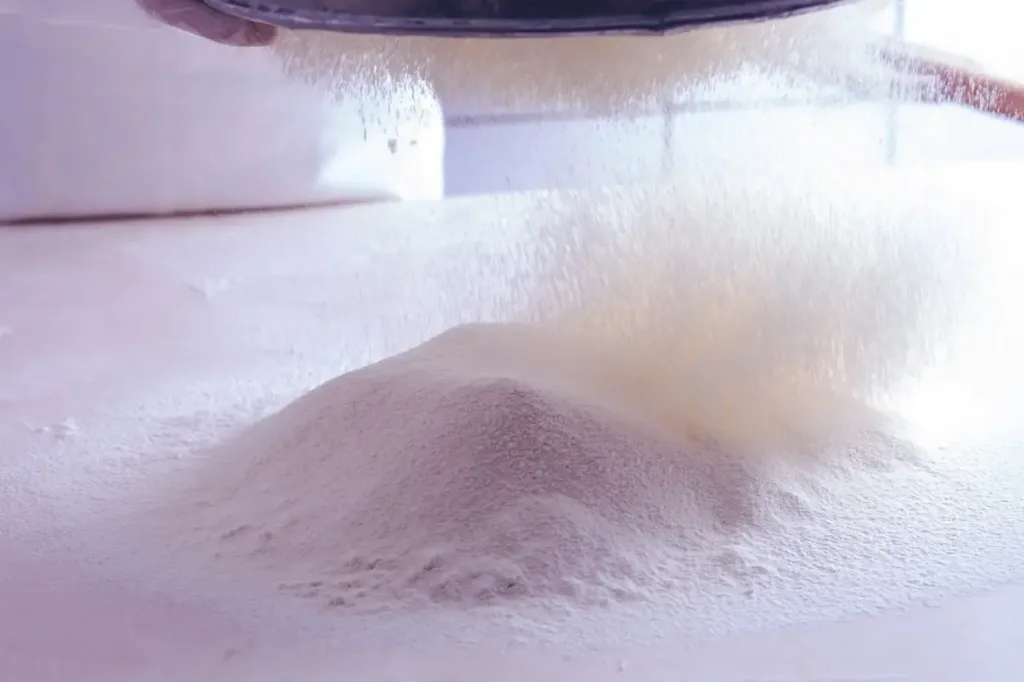
Pneumatic Conveying Application – Grout Processing Plant: Dense-phase conveying systems for sand and cement, and dilute-phase conveying systems for silica flour and calcium carbonate. The project included dense-phase vessels, an air management system retrofit, diverters, bin vents, and controls.
- The Material: Sand, cement (two colors), silica flour, and calcium carbonate
- The Solution: Our customer manufactures grout and mortar. We installed two new dense-phase systems and retrofitted an existing one to eliminate boosters and increase the rate. We also installed diverters to route material to a new mixer alongside the existing mixers. Weighing systems were installed on the pressure vessels for the dense-phase systems or on the receiving bins for the dilute-phase systems to improve batch accuracy and shorten mixing cycles.
Pneumatic and Packaging Application – Oil Field Additive: This solution included two dense-phase ASME code vessels, a control system, bin vents, a large hopper, dust collection, rotary valves, and a vacuum-dilute reclaim system. It also included three impeller packers, conveyors, a robot placer, check-weigh, inkjet printing, a robot palletizer, pallet dispensing and conveying, a stretch hood machine, and gravity accumulation.
- The Solution: Our customer built a new facility to import Barite, grind it to a specified particle size, and sell it to customers. Dense-phase pneumatic transfer systems move Barite from two milling/grinding locations to four silos across the plant. The Barite was then transferred to multiple 50 lb and 100 lb bagging stations, where robots placed empty bags onto impeller packers for filling. Once filled, the bags traveled on roller conveyors to be robotically palletized. Once the pallets were full, they were transferred to a stretch hood machine and securely wrapped for transport to the oil field. Finally, dust collection and reclaim systems were installed to reuse material sustainably.
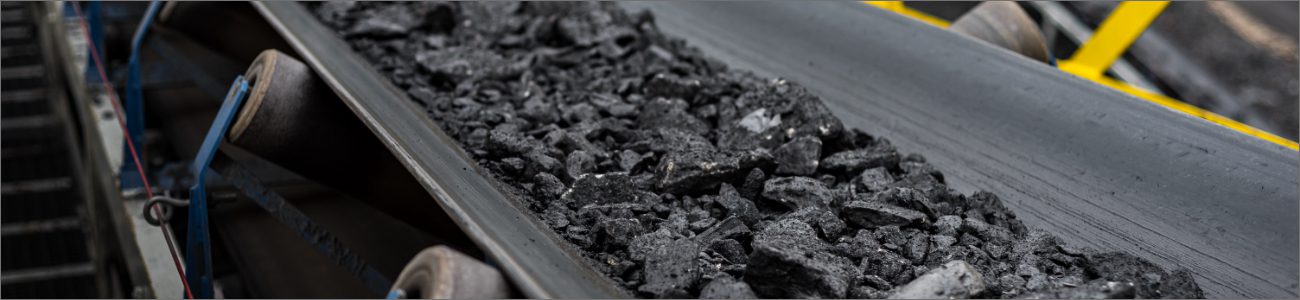
Pneumatic Application – Cement Plant: Vacuum blower, filter receiver, rotary valves, knife gate valves, hoppers, multiple vacuum pickup points, and an inlet filter.
- The Solution: The customer had problems with mechanical conveying breaking down—the time and cost of repairs were hurting the customer’s business. We proposed a pneumatic system to convey bulk and minor additives to storage or to a mixer. The vacuum system conveyed the additives to a filter receiver above a mixer, providing a more reliable means of transferring the material and reducing equipment failures.
YEARS
Over a century of engineering, automation, and system integration experience driving manufacturing transformation.
PROJECTS
Magnum’s track record of delivering high-performance automation solutions for bulk material handling and packaging.
CSIA-CERTIFIED CONTROL SYSTEMS EXPERTISE
Excellence in batch and process control automation—a trusted benchmark for industrial automation.