Expertise Test Lab

Test Lab

We run your material through real equipment to see how it flows, conveys, and performs before it’s built into the system.

Every material behaves differently. Testing removes the guesswork.

From conveying to filling, we test how your material moves and expose potential issues. You get data you can trust, not assumptions, so systems are designed around real performance.

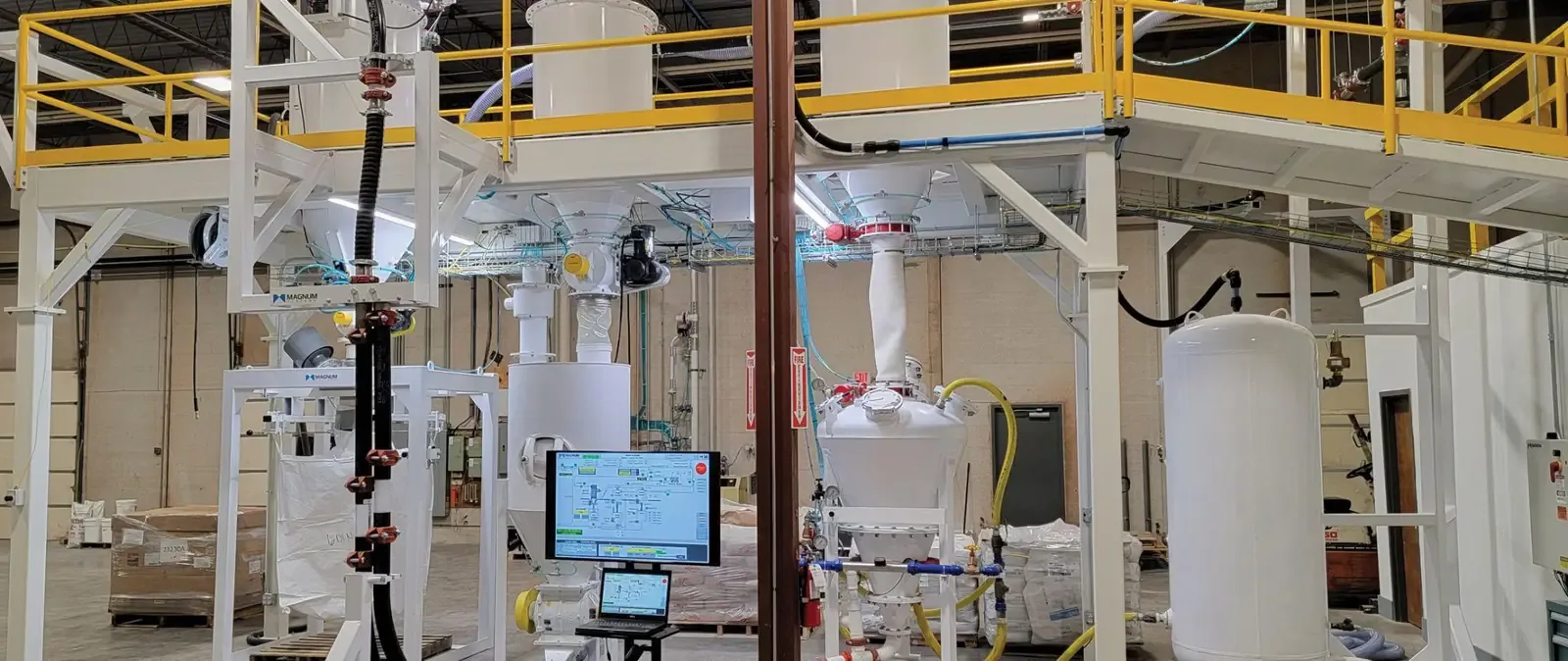
Magnum test lab with a bulk bag unloader, receivers, and pressure vessel beneath a yellow-railed mezzanine, HMI monitor in front.

Knowing with certainty how your material will perform when pneumatically conveyed or precisely metered into a bag is critical to your system’s success. To ensure our system is designed and sized for the most cost-effective method of conveying and packaging materials, we test your material for flow characteristics, filling and convey design parameters, and degradation in a real-time operational system.

Testing Dictates the Right Components & System to Move Your Material

Every type of material, no matter how common, behaves differently. Let’s say you’re pneumatically conveying and bagging flour. The type of material (soy, flax, etc.), its origin (imported or domestic), and the plant’s environment affect how the material behaves.

Preliminary material testing removes any uncertainty about your dry bulk materials’ performance and determines the best solution for handling them. This due diligence ensures your system and its components keep the line moving exactly as expected throughout their lifespan, with minimal downtime or mechanical disruptions.

Decades of Material Testing Experience

Magnum Systems has conducted material testing for decades in a variety of industries, including:

  • Ag Feed & Seed
  • Animal Feed & Pet Food
  • Cement
  • Chemicals
  • Food
  • Plastics

Our team’s collective experience makes Magnum an exceptional partner for material testing. Our outcomes provide the data required on material properties to design and engineer the right system for strength, durability, and performance. Magnum Systems’ material testing expertise helps you avoid the expense and inefficiency of second-guessing and retooling later.

Magnum Systems offers both pre-sale and post-sale testing services.

  • Pre-Sale Testing and Equipment Demonstration
    We encourage clients to utilize our pneumatic conveying and packaging testing capabilities to validate proof of concept for the best solution to handle their product. Additionally, pre-sale demonstrations allow you to identify concerns, determine customized features, and simulate real-world scenarios. They also give Magnum valuable insight into designing the optimum system for our customers’ material. We provide both in-person and video witness testing. Upon completion of the test, a complete report covering any suggestions or modifications will be generated and shared with you.
  • Post-Sale Factory Acceptance Test (FAT)
    We are also equipped to set up your bag-filling system at our facility for a witnessed Factory Acceptance Test (FAT). A FAT includes check-out and training on equipment operation, maintenance, troubleshooting, and finalization. Our sales, engineering, and technical service staff are prepared to answer questions during the FAT visit to ensure you are confident in the equipment’s functionality and capability BEFORE it reaches your facility.

Note — All Factory Acceptance Test(s) (FAT) performed are subject to a fee, this will be determined prior to execution and included in formal proposal.


Explore More To Run Better

See how testing informs system design and improves performance before startup.

Market-Leading Insights

Learn about the importance of testing, and what it reveals about material behavior and system performance.

More Success Stories

See real-world examples where Magnum testing changed the approach and improved the outcome.

Request a Proposal

Have a material you’re unsure about? We’re sure testing will get you the answers you need.

Related News & Resources

Find out more about how material testing leads to better system design and improved performance.

An operator works at a workstation with four computer monitors displaying control panel interfaces and data dashboards in a monitoring room.

Building Cyber-Resilient Process Control Systems: 9 Practical Steps to Protect Your Digital Investments

A single cyberattack can halt production, corrupt data, and cost you days of lost output. That’s why more plant leaders are asking the same question: how do we build cyber-resilient process control systems that reduce the risk of downtime and keep operations running? The good news is that resilience isn’t luck. It’s a disciplined, repeatable process you can start today. Why Cyber Resilience Matters Now Your plant floor runs on connected technology. PLCs, HMIs, SCADA platforms, and networked instrumentation communicate with each other and with your business systems. That connectivity drives efficiency, but it also expands your attack surface. For decision-makers, the …
Continue Reading 
A light-skinned man wearing a white hardhat and reflective vest points with a pen at multiple computer screens showing data and charts in a control room.

The Competitive Edge You’re Missing: Why Controls Integration and System Integration Are Better Together

Running a plant, or multiple plants, means managing a web of moving parts. Equipment communicates with software. Software talks to operators. Operators make timely decisions based on data they are confident is accurate and available in real time. But when your systems aren’t truly unified, the web quickly frays. This is why it is critical to understand the difference between system integration and controls integration—and, more importantly, why combining them is a game-changer for operational leaders like you. What Is System Integration? System integration is the process of connecting your disparate IT and OT (operational technology) platforms into a single, cohesive …
Continue Reading 
Get Started